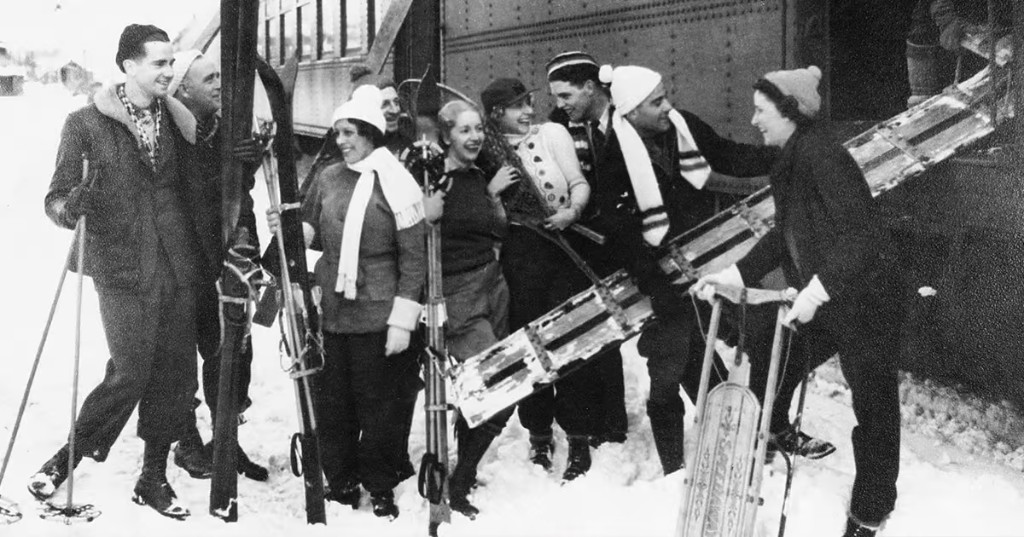
Skiers and sleds beside a passenger train in the snow
Exploratory passenger rail proposal · November 2026

From the Bay
to the Sierra
by rail.

What if the Capitol Corridor continued over Donner Pass to a year-round Donner Summit stop, Truckee and Reno? Explore published timetables, railroad constraints, state plans and a realistic—but still hypothetical—operating concept.

Explore the timetables ↓
01 / Route map

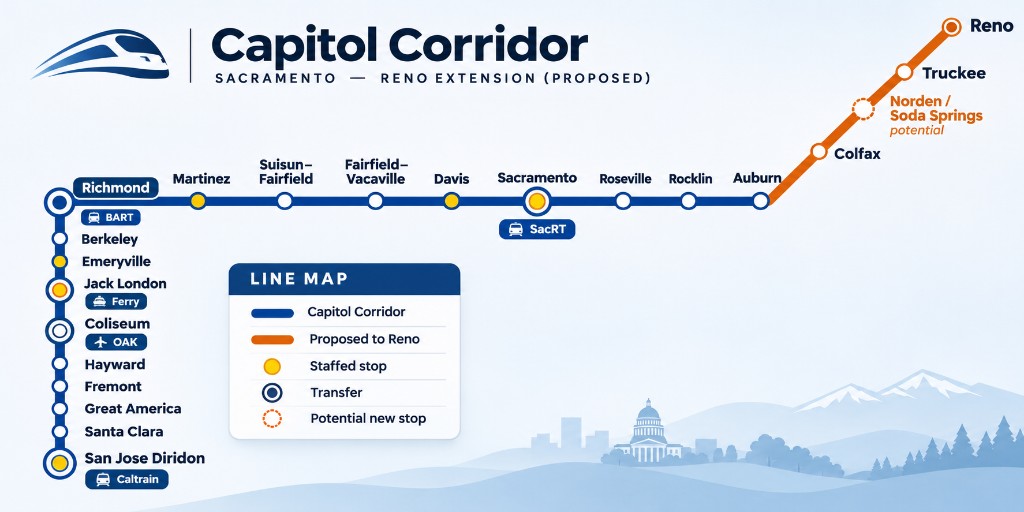
Today’s Capitol Corridor, plus the mountain

Blue is the train that runs now, San Jose to Auburn. Orange is the proposed rail extension over Donner Pass. Colfax, Truckee and Reno already see the California Zephyr; Norden / Soda Springs would be a new stop.

Schematic map of the Capitol Corridor from San Jose to Auburn, with a proposed extension to Colfax, Norden or Soda Springs, Truckee and Reno. Transfers at San Jose Diridon, Coliseum, Jack London, Richmond and Sacramento.

Proposal schematic, not a geographic track map.

02 / Timetable

Today’s trains, plus four proposed Reno round trips

Green is the Capitol Corridor as published. Blue is the daily California Zephyr. Orange is proposed — four daily round trips over Donner Pass, not operating, and with no track upgrades.

Proposed round trips/day4
Trainsets · simplified rotation4
Reno same-day turns~1h 55m
Existing Zephyr+1 daily
Capitol CorridorCalifornia ZephyrProposed — not operating

Orange columns are not running. They are a midpoint concept in the regional 2–6 round-trip range, not a dispatcher-approved schedule. Proposed R2 uses the published 7:48 AM Oakland departure of Capitol 720 and extends it beyond Sacramento. That would take a trainset out of today’s cycle unless it is backfilled.

Trainset cycle: Reno turns

Eastbound R1 → Westbound R3
Reno arrival 11:45 AM → departure 1:40 PM (1h 55m)
Eastbound R2 → Westbound R4
2:13 PM → 4:10 PM (1h 57m)

Two morning Oakland-origin sets return west after a short Reno layover. The later eastbound arrivals are stored overnight to provide the next day's early westbound departures.

Trainset cycle: Oakland turns

Westbound R1 → Eastbound R3
Oakland arrival 12:45 PM → departure 1:30 PM (45m)
Westbound R2 → Eastbound R4
3:15 PM → 4:00 PM (45m)

Two Reno-origin sets return east after a short Oakland layover. Two trainsets start at each end each morning, for four total in a simplified repeating circulation.

Capitol Corridor times come from the GTFS ZIP (late October 2026–early January 2027). Zephyr #5 and #6 times come from the November 9, 2026 Amtrak timetable. Holiday calendars can differ. This is a schedule reference, not a bookable service.
03 / Maximum authorized speeds

How quickly could a train get from Oakland to Truckee?

A genuine milepost-by-milepost line-speed integration, rather than assuming 30 mph for the entire Sierra. Uses the 2009 Union Pacific passenger speed tables for Martinez (Track 2) and Roseville Subdivisions (normal eastward movement). Not a current speed certification.

Absolute speed-only floor
4h 32m

From about Martinez Sub MP 2.2 near Oakland's rail junction to Truckee MP 205.9. Assumes instantaneous acceleration, no stops, no dispatching delay.

Distance represented
203.7 mi

Timetable milepost distance, not an independently surveyed station-to-station distance. The exact Jack London station approach is not modeled.

Illustrative limited-stop time
5h 02m

Add 30 minutes for station stops, accelerating, braking, and operations. Still not a dispatch-validated schedule.

Maximum passenger speed along the route

The red low-speed plateau from Colfax almost to Truckee is why the mountain climb dominates.

50–79 mph35–49 mph20–30 mph

Detailed fastest-time calculation

Source: Union Pacific Roseville Area Timetable #5 (2009), Martinez Subdivision p. 34 and Roseville Subdivision pp. 24–25. Signal or turnout routing through additional slow tracks could increase the floor.

From mathematical floor to a train schedule

Choose extra minutes to represent real-world starts, stops, crossing clearance and train-performance margin.

5h 02m

Not a simulation: adding 30 minutes is only an illustrative adjustment. A fully operational timetable must account for other trains, meets, dwell and equipment performance.

With no track improvements, the timetable speed-only floor is about 4h 32m. Treat a 5–5½ hour Oakland–Truckee express as a preliminary planning range, not a promised schedule.
04 / Physical railroad

The line is double-track almost all the way

Two narrow sections remain on Donner Pass. Their lengths and mileposts come directly from Union Pacific's 2009 Roseville Subdivision timetable; current conditions should be verified before engineering decisions.

Track configuration — Roseville to Reno

To scale by railroad milepost · orange indicates a single main track

Two main tracksSingle track
Bottleneck one

Switch 9 → Shed 10

MP 171.2–178.2 · 7.0 miles. Trains share one main track near Emigrant Gap and Cisco.

Bottleneck two

East Norden → Shed 47

MP 192.5–196.6 · 4.1 miles. Includes the Tunnel 41 summit crossing.

Important nuance

At Norden

West Norden–East Norden (MP 191.2–192.5) was a two-main-track section in 2009, but a particular movement there has a 20 mph restriction.

This is a schematic of the 2009 employee timetable, not a modern certified track map. Track directionality and signaling can limit flexibility even where two mains are shown.
05 / Faster or more often

What would faster service, or more trains, cost?

Two different problems. Cutting the ~5 hour Oakland–Truckee time means higher mountain speeds. Adding passenger round trips means finding slots on a freight railroad. Neither has a current project estimate.

Faster trips

The mountain is mostly 30 mph

That authorized-speed plateau from Colfax toward Truckee is why the trip is about five hours with no upgrades. Restoring the 11.1 miles of single track would help meets and reliability. It would not, by itself, make a 50–60 mph passenger railroad.

More trains

~15 trains/day reported now

An FRA crossing-inventory figure near Norden, both directions, including passenger trains. Not live dispatching data. A rough mixed-traffic range on the current line is 25–40 trains/day. Not a Union Pacific capacity rating. Four extra daily passenger round trips would have to fit inside whatever freight windows actually exist.

Very rough cost

$260M–$820M

Previously discussed order-of-magnitude cost for restoring both single-track sections, related signaling, and selective clearance. Not a project estimate. A 40–60 mph mountain speed-up would be additional work, unpriced here.

A practical next step is a timetable-led capacity simulation with Union Pacific’s actual occupation, then the smallest infrastructure that buys reliable passenger slots or a shorter running time. These dollar and train-count figures are exploratory.
06 / Government plans

What California is actually planning

There is a gap between the state's adopted plan, the Capitol Corridor regional vision, and a funded construction commitment. The links below lead to primary agencies and current source pages.

Official statewide plan

California State Rail Plan (2024)

Released in 2025. The main Sacramento–Reno service concept continues to feature integrated bus service, while a long-term seasonal Reno rail item appears in project appendices. No fixed Reno train schedule or Summit station funded.

Caltrans plan and appendices ↗
Regional long-range vision

Capitol Corridor Vision Plan (2026)

Discusses longer-range extension toward Truckee/Reno, with a 2–6 round-trips/day aspiration cited in planning discussions. Not a committed timetable or UP train-path agreement.

Vision Plan ↗
Feasibility & local planning

Placer County / Sacramento–Reno

Planning work has considered the Auburn–Reno corridor, station access, and infrastructure. Sacramento–Roseville third-track projects are more advanced than the mountain extension.

Placer County rail page ↗

What's not funded or approved

A year-round Norden/Soda Springs passenger platform, new Reno train paths, double-track restoration over the summit, or a 40–60 mph mountain speed-up have no confirmed committed construction funding in the sources reviewed.

How to move the proposal forward

Document a 2-round-trip timetable → run dispatching and station studies with UP → model equipment cycles and winter access → estimate construction and operating subsidies → seek state, federal and railroad agreements.

07 / Ski train

Skiers used to arrive by train

Southern Pacific ran winter trains from the Bay Area to Norden, Soda Springs and Truckee. The Donner Summit Historical Society has the fullest accounts.

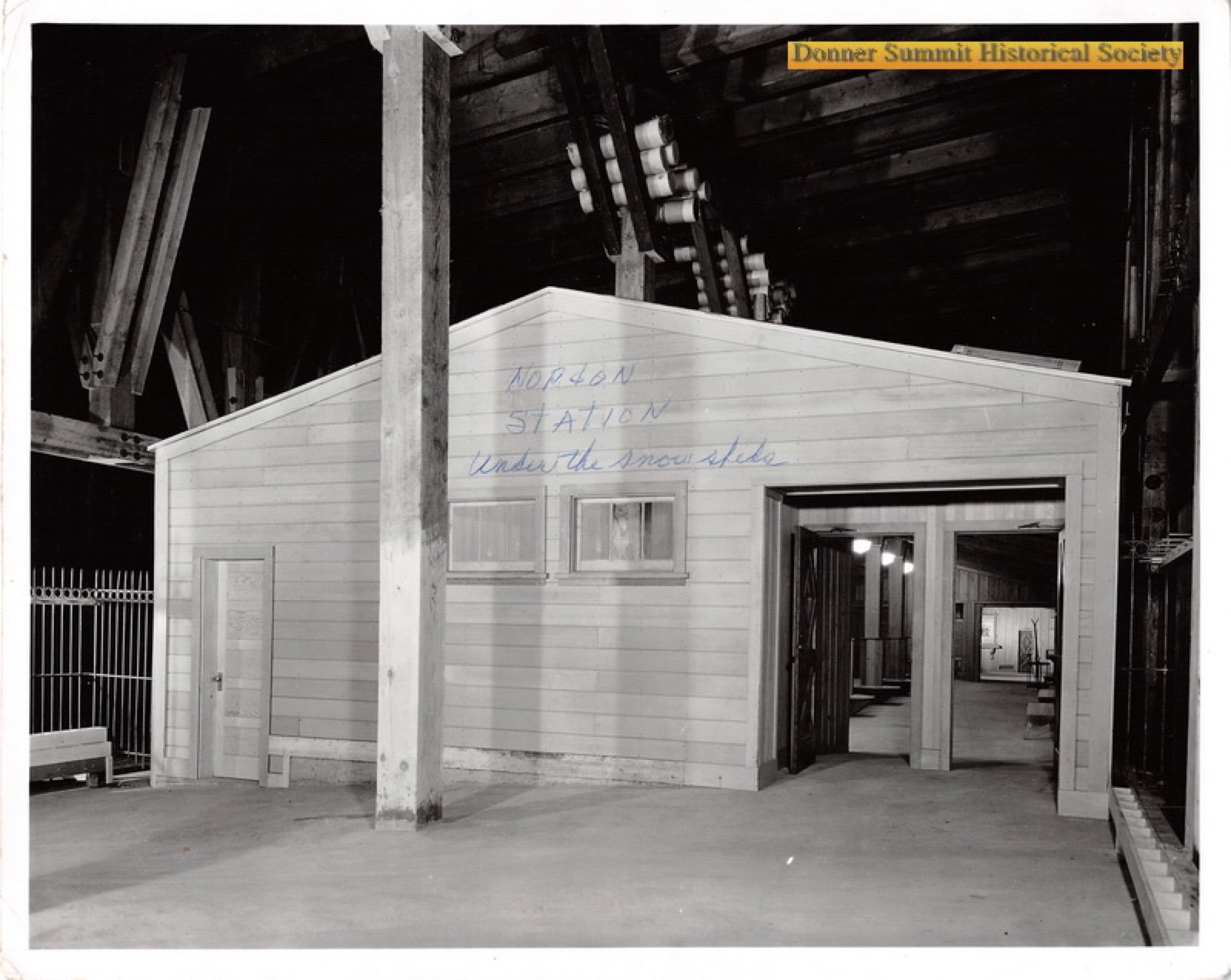
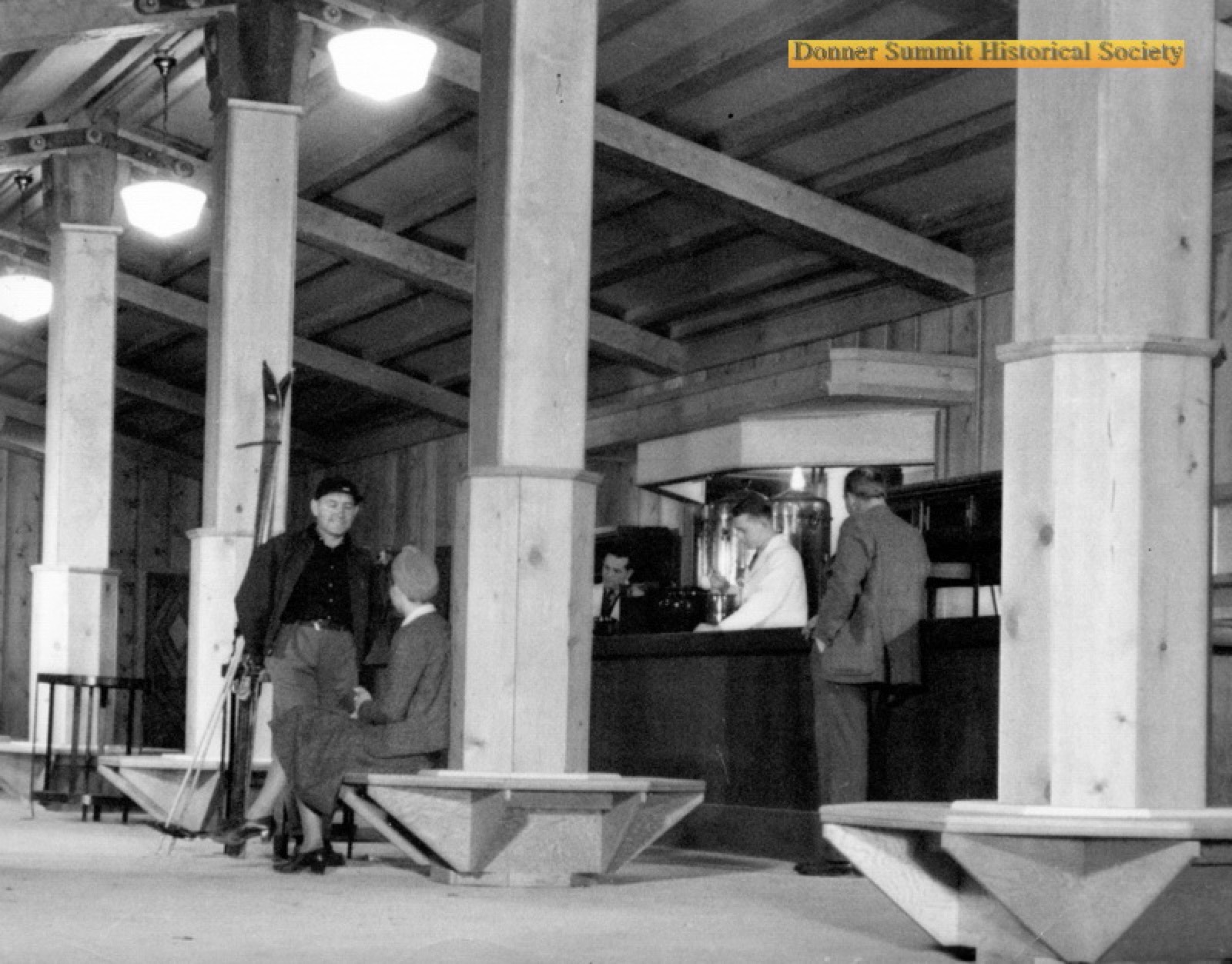
From the early 1930s into World War II, Southern Pacific sold winter trips over Donner Pass as Snowball Specials, also advertised as the Snowball Express. Overnight trains left San Francisco in the evening and arrived at Norden in the morning. When Sugar Bowl opened in 1939, SP built a ski hut inside the Norden snowsheds. Tractor sleighs ran to the resort, and a car on the train rented skis. Extra sleeping cars were parked in Truckee for weekend berths.

A Southern Pacific railroad history summarized by the Historical Society says the specials became so popular they needed about 60 extra trains in a January–March season. World War II ended the service. Automobile travel kept it from returning. The California Zephyr still crosses Donner Pass; it does not stop at Norden.

Photographs

Photographs from the Historical Society

From the Donner Summit Historical Society. Many in their collection come from the Norm Sayler archive.

Keeping the railroad open

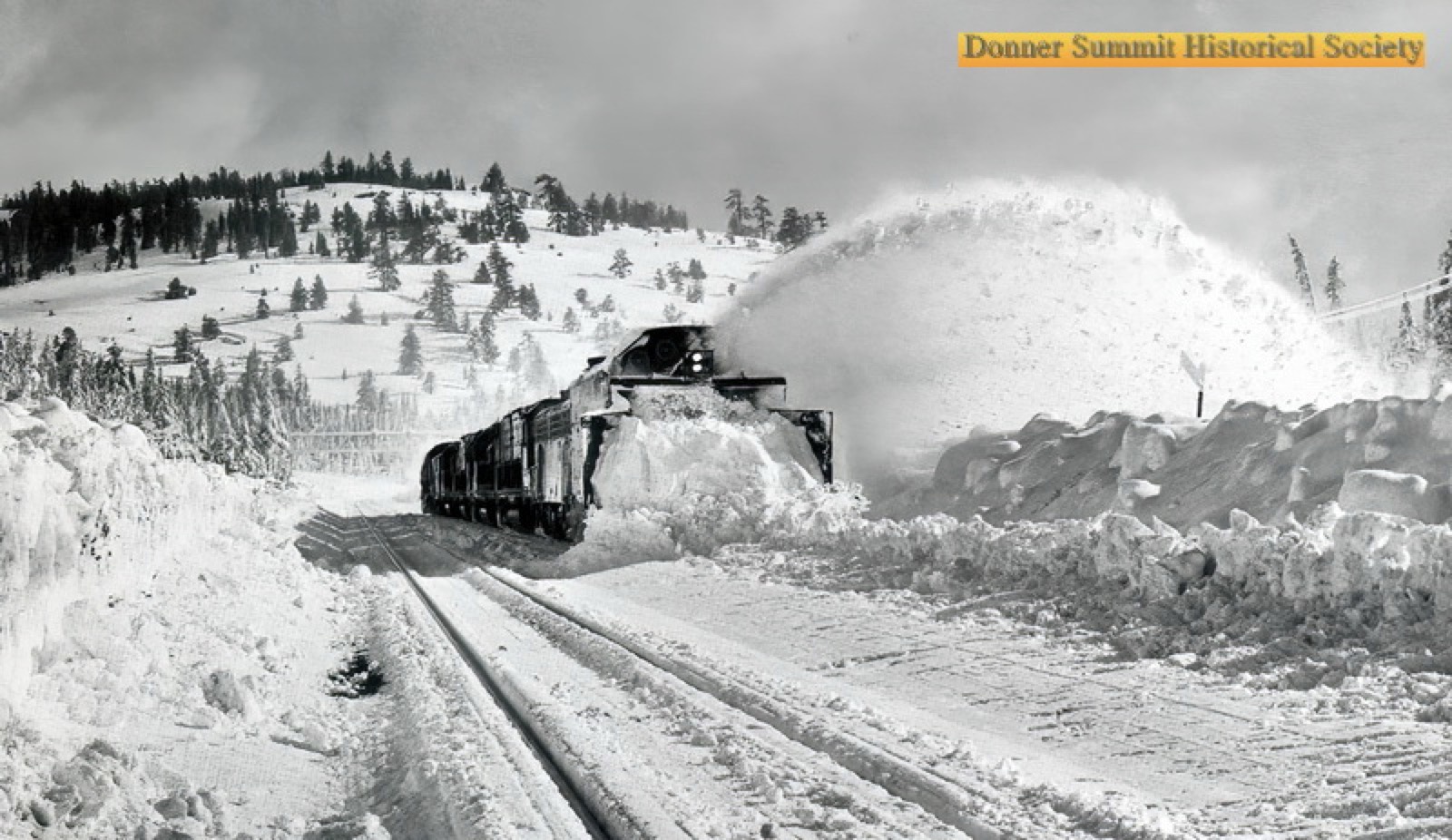
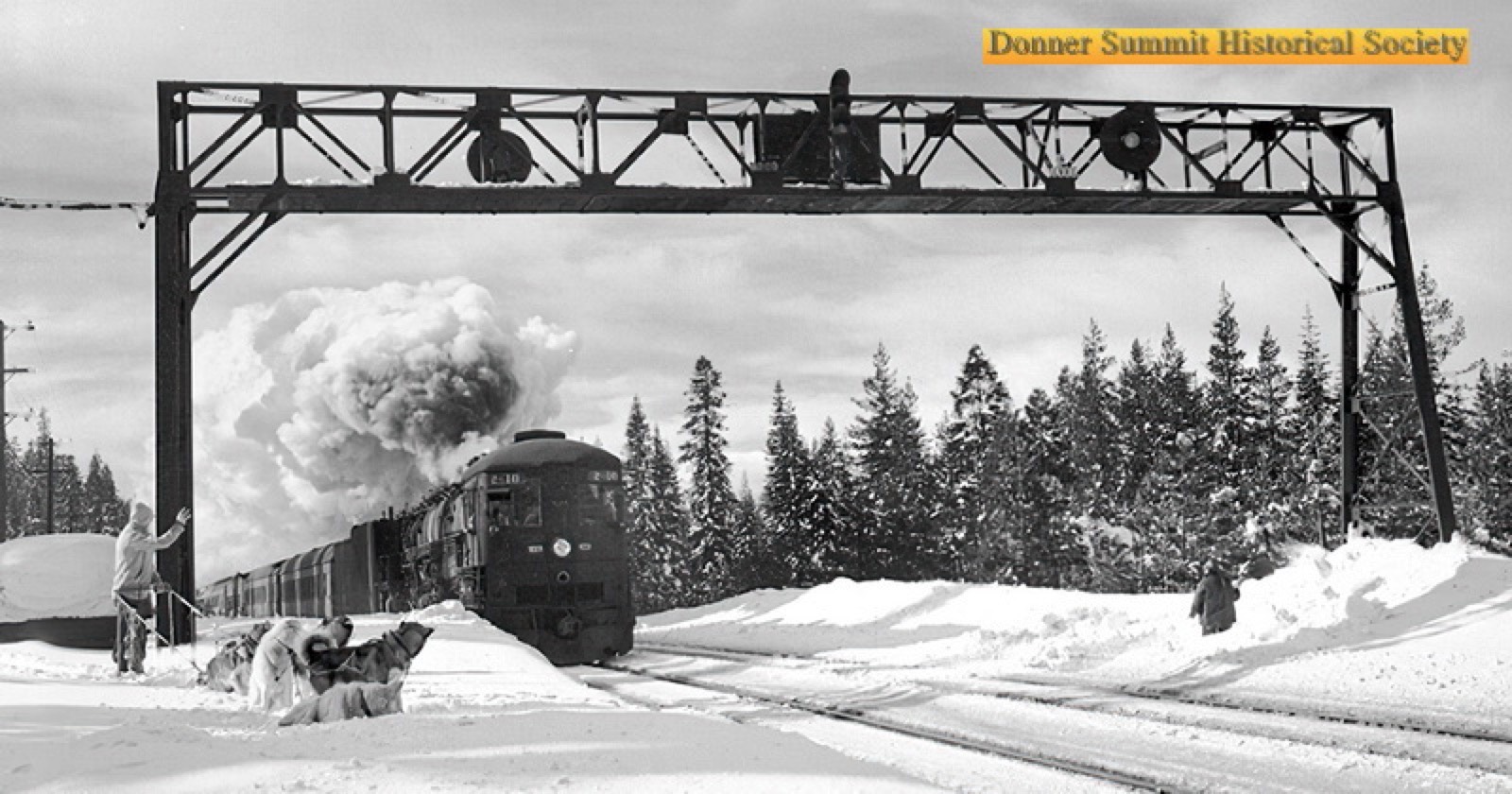
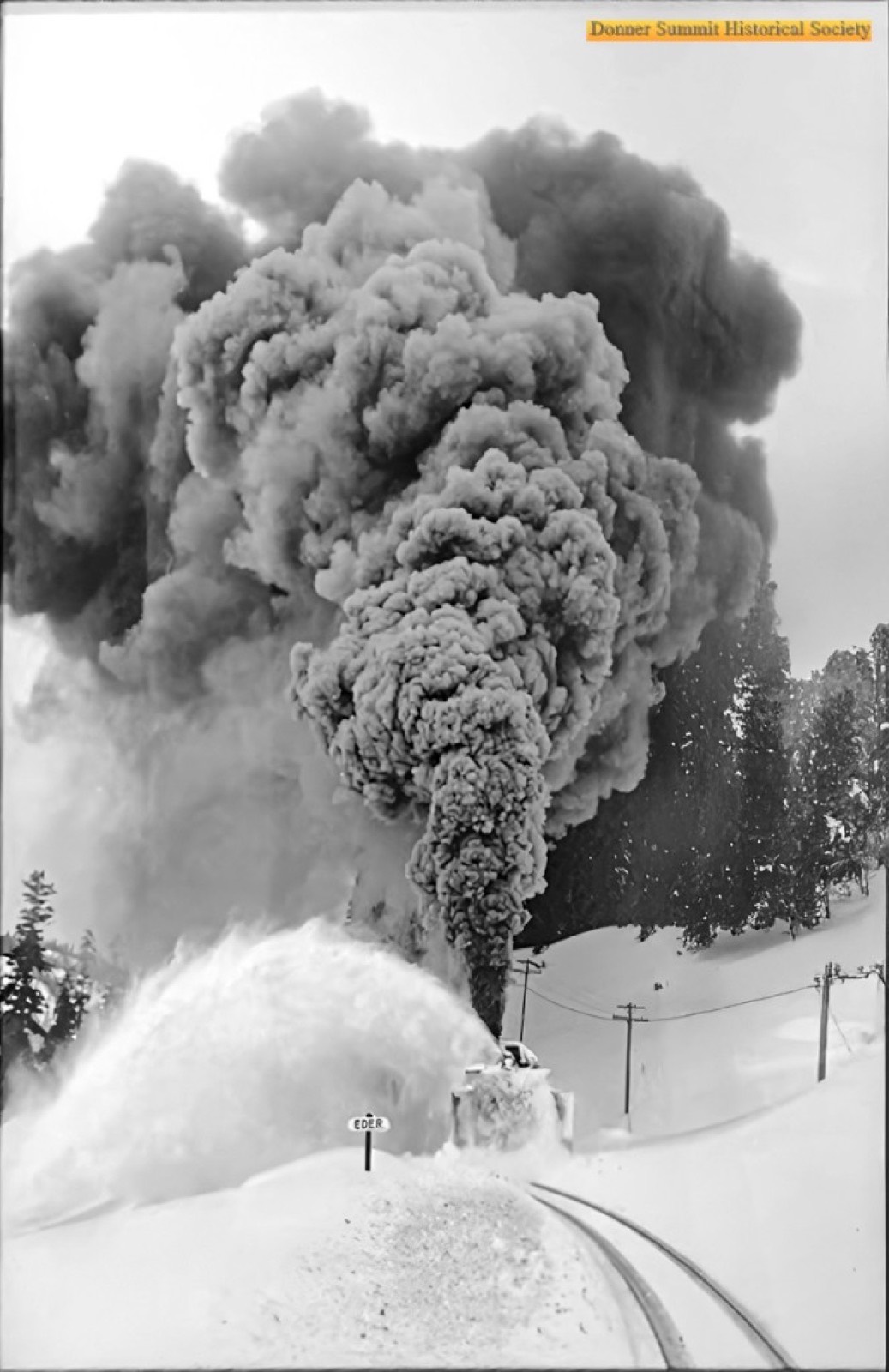
Rotary plows and winter trains on Donner Summit.

A rotary snowplow throws a wall of snow beside a freight on Donner Summit
Rotary plow on Donner Summit.
A westbound train under a signal bridge in snow, with a dog team in the foreground
Winter train under the signal bridge.
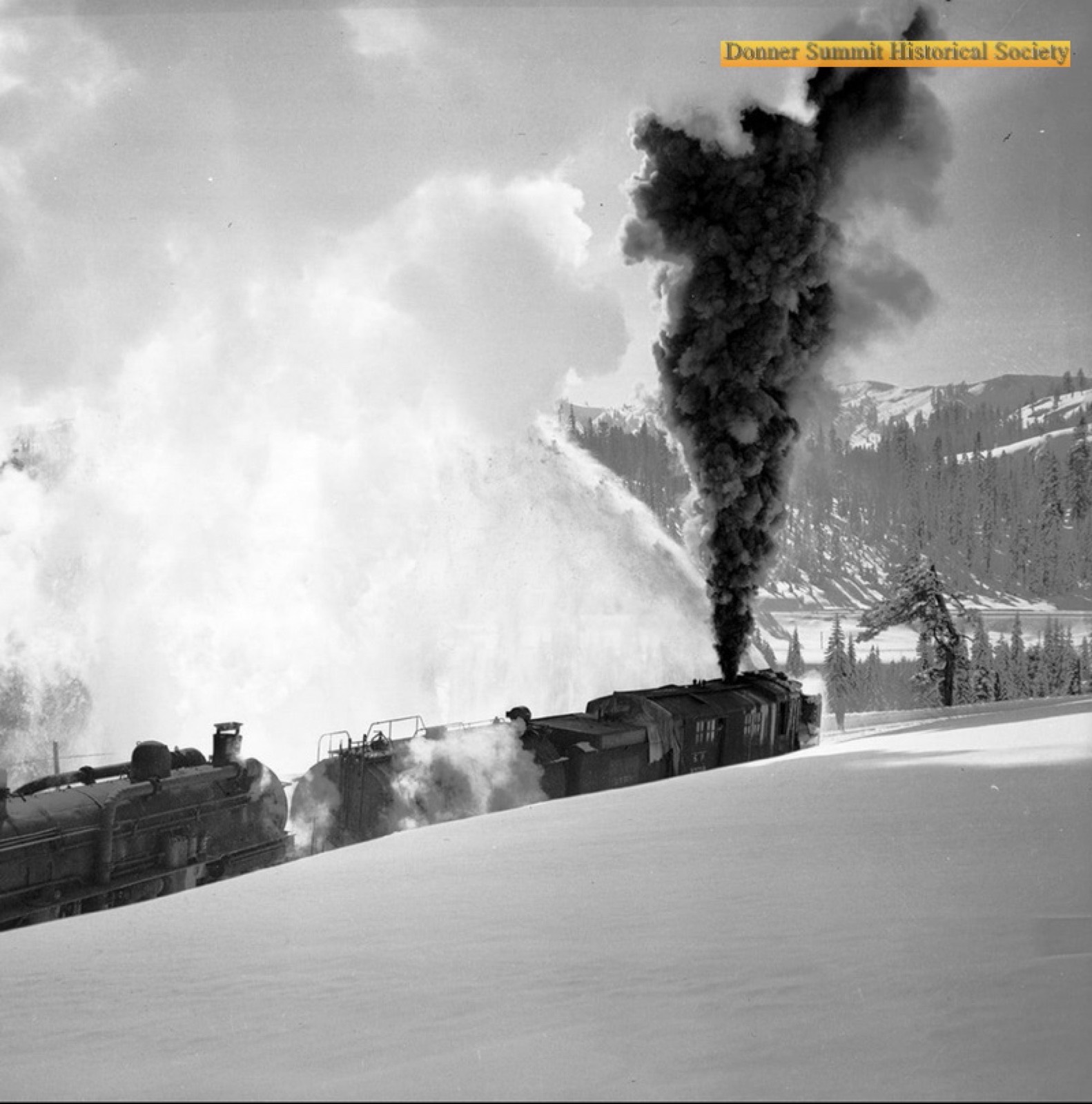
A steam rotary snowplow at Eder throws snow and a tall column of smoke
Rotary at Eder.
A steam locomotive and rotary plow throwing snow on Donner Pass
Steam rotary on the pass.

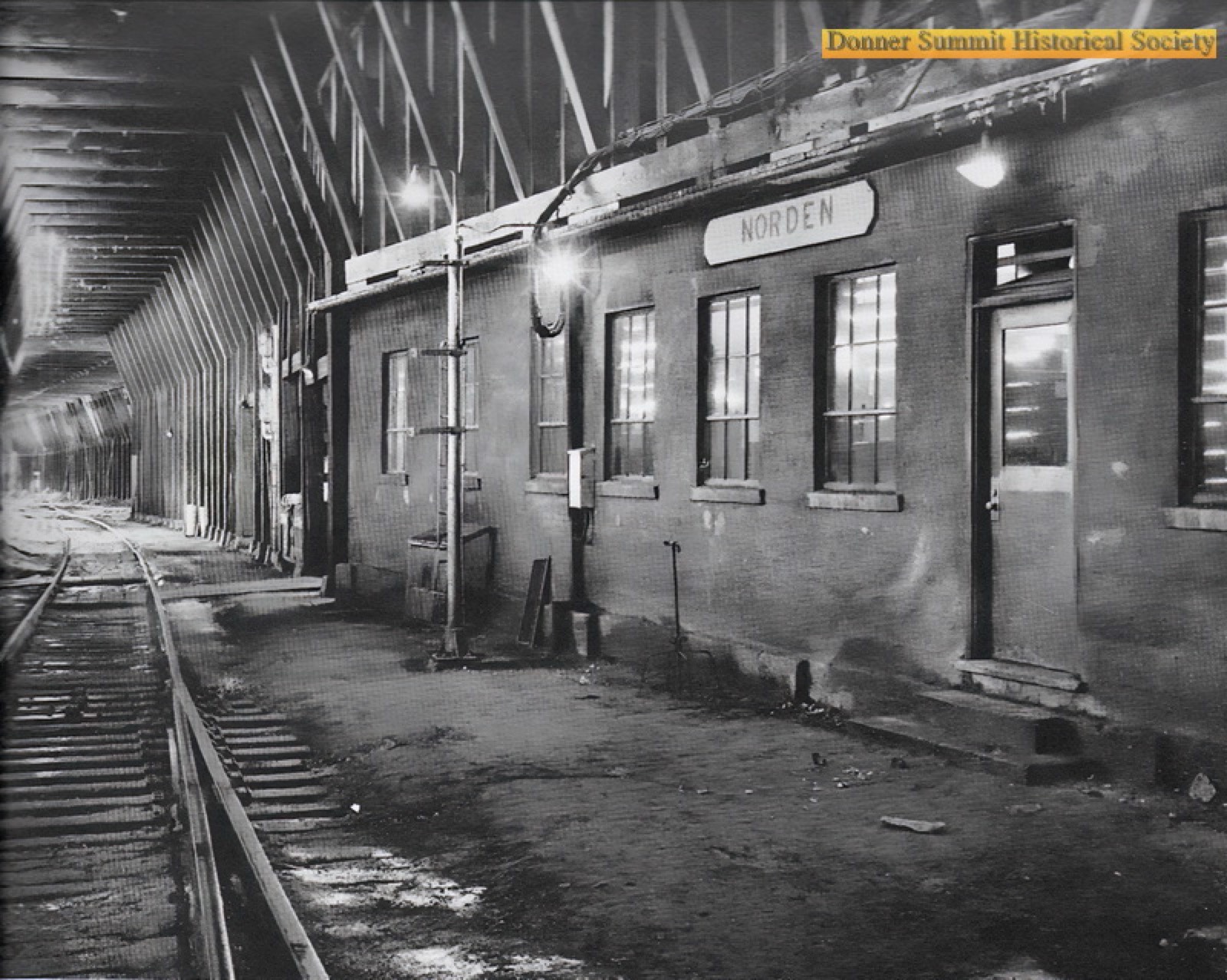
Norden station

The passenger stop and ski hut sat inside the snowsheds.

Wooden building labeled Norden Station Under the Snowsheds, inside a large shed
Norden station under the snowsheds.
Brick Norden depot with a station sign, inside the snowshed beside the track
Norden depot in the shed.
Skiers at the lunch counter in the Norden ski hut
Lunch counter in the ski hut.
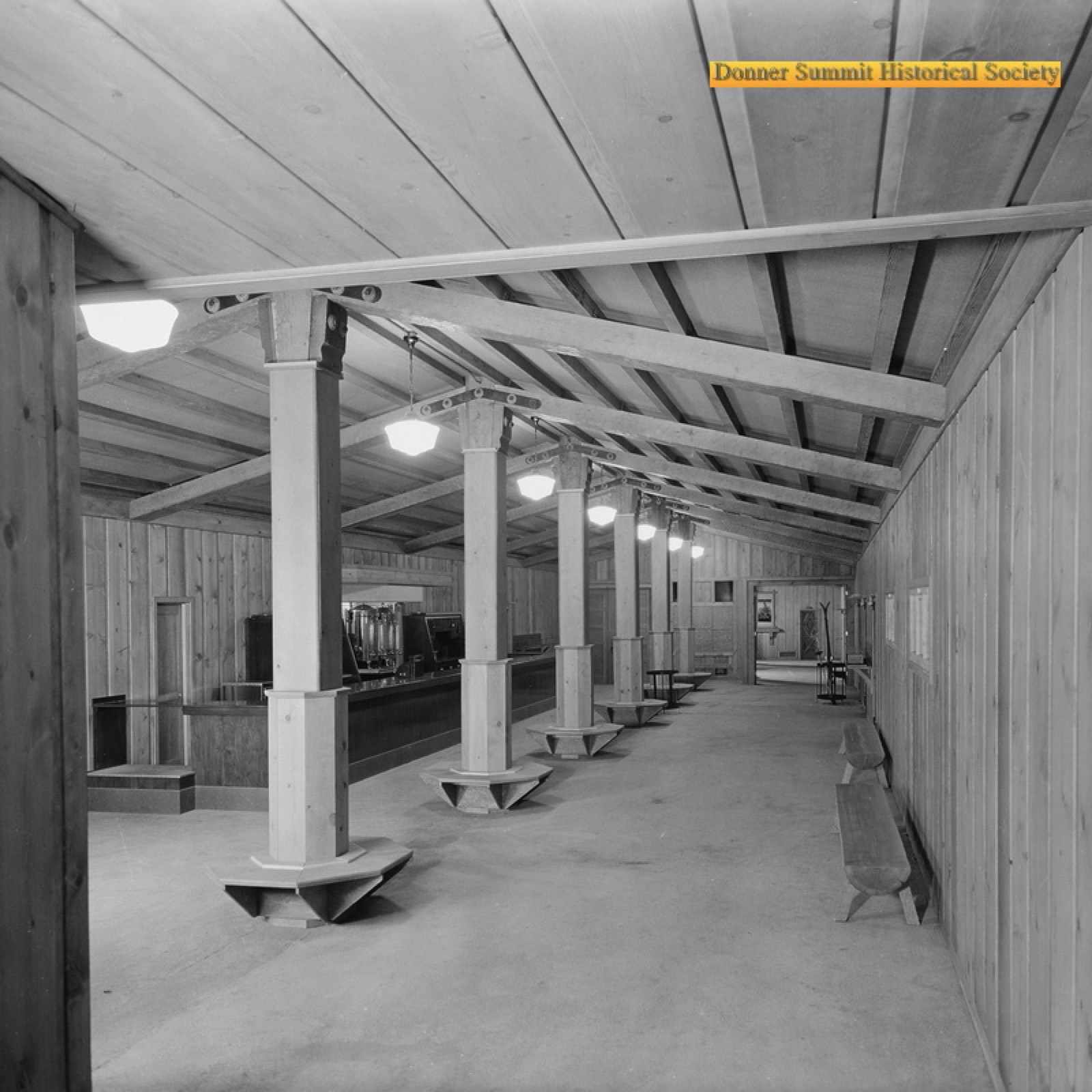
Empty waiting room of the Norden ski hut, with a long bar and wooden columns
Ski hut waiting room.

How you got there

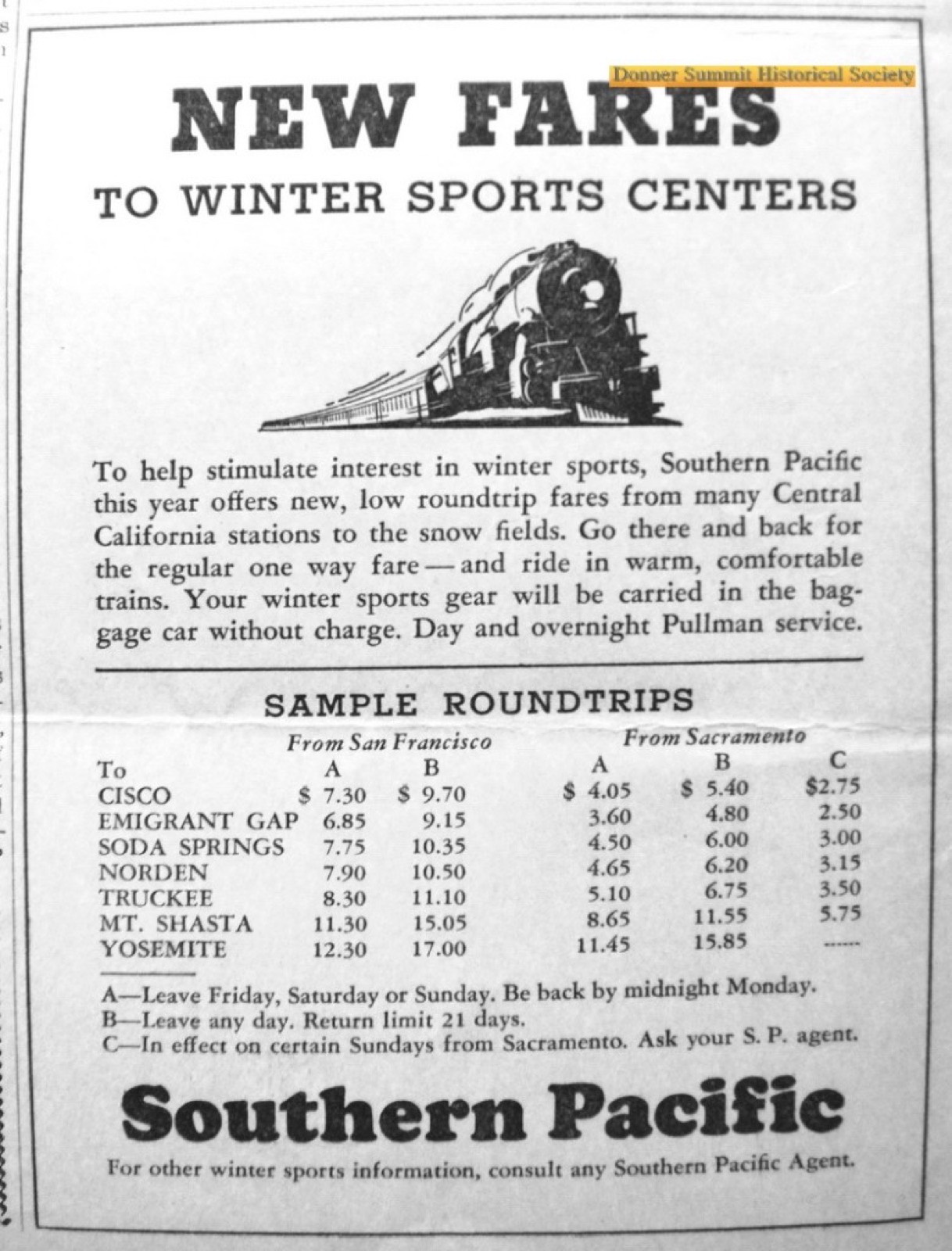
Southern Pacific sold overnight trains and weekend fares to Norden, Soda Springs, Truckee and Reno.

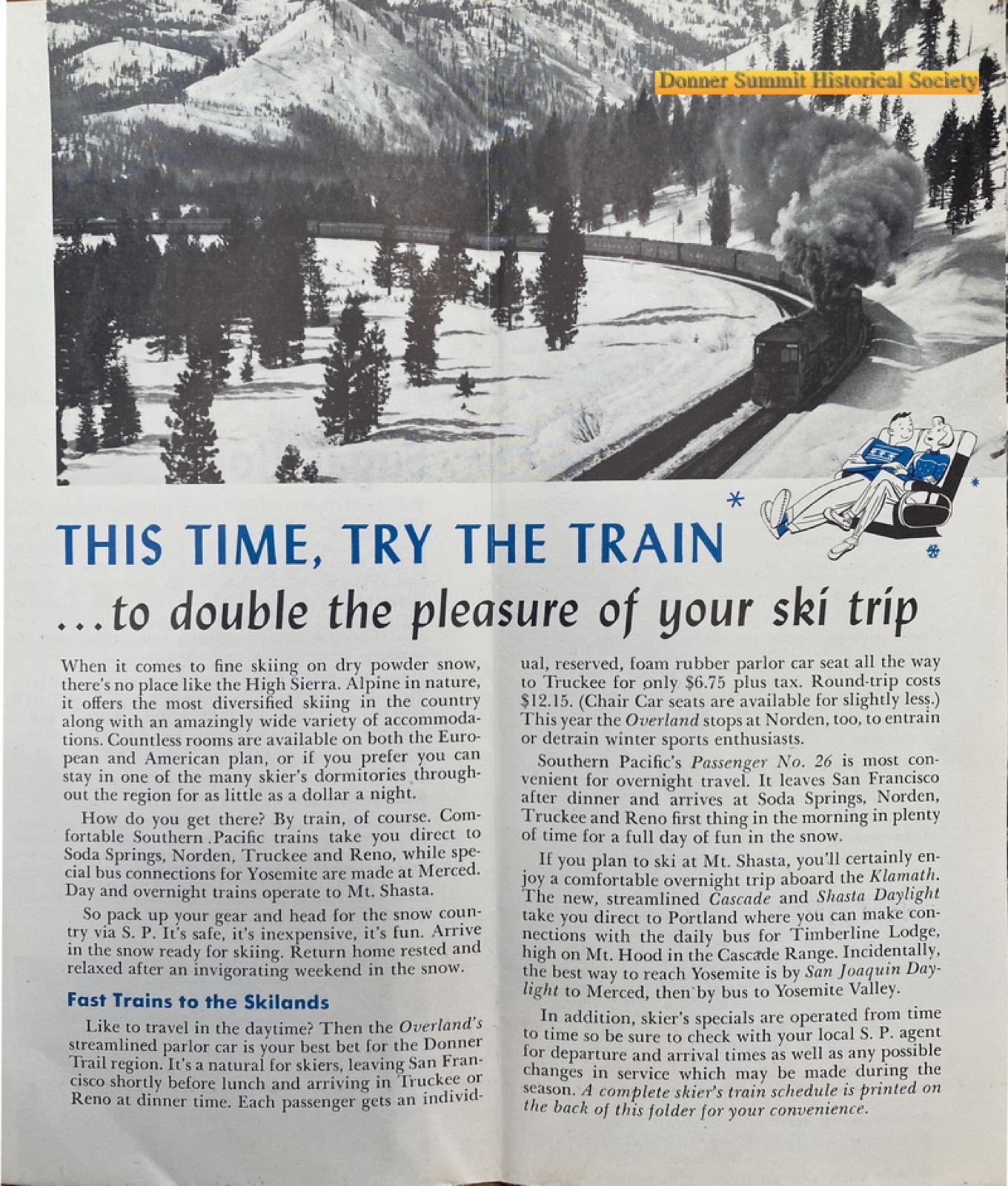
Southern Pacific brochure titled This time, try the train, to double the pleasure of your ski trip
SP ski-train brochure: “This time, try the train.”
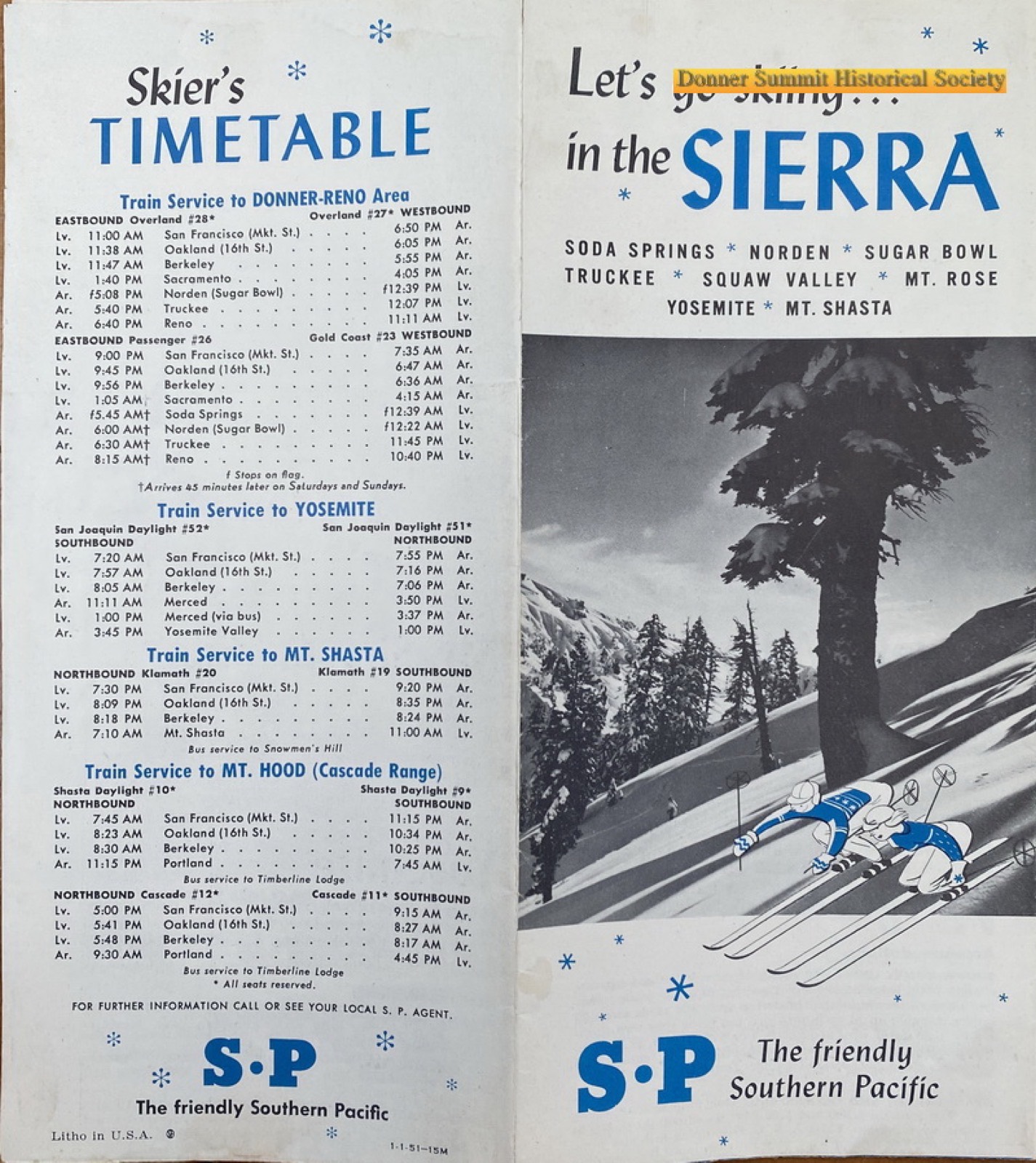
Skier’s timetable for Southern Pacific trains to the Donner-Reno area, including Norden and Truckee
Skier’s timetable: Overland and Passenger 26 to Norden and Truckee.
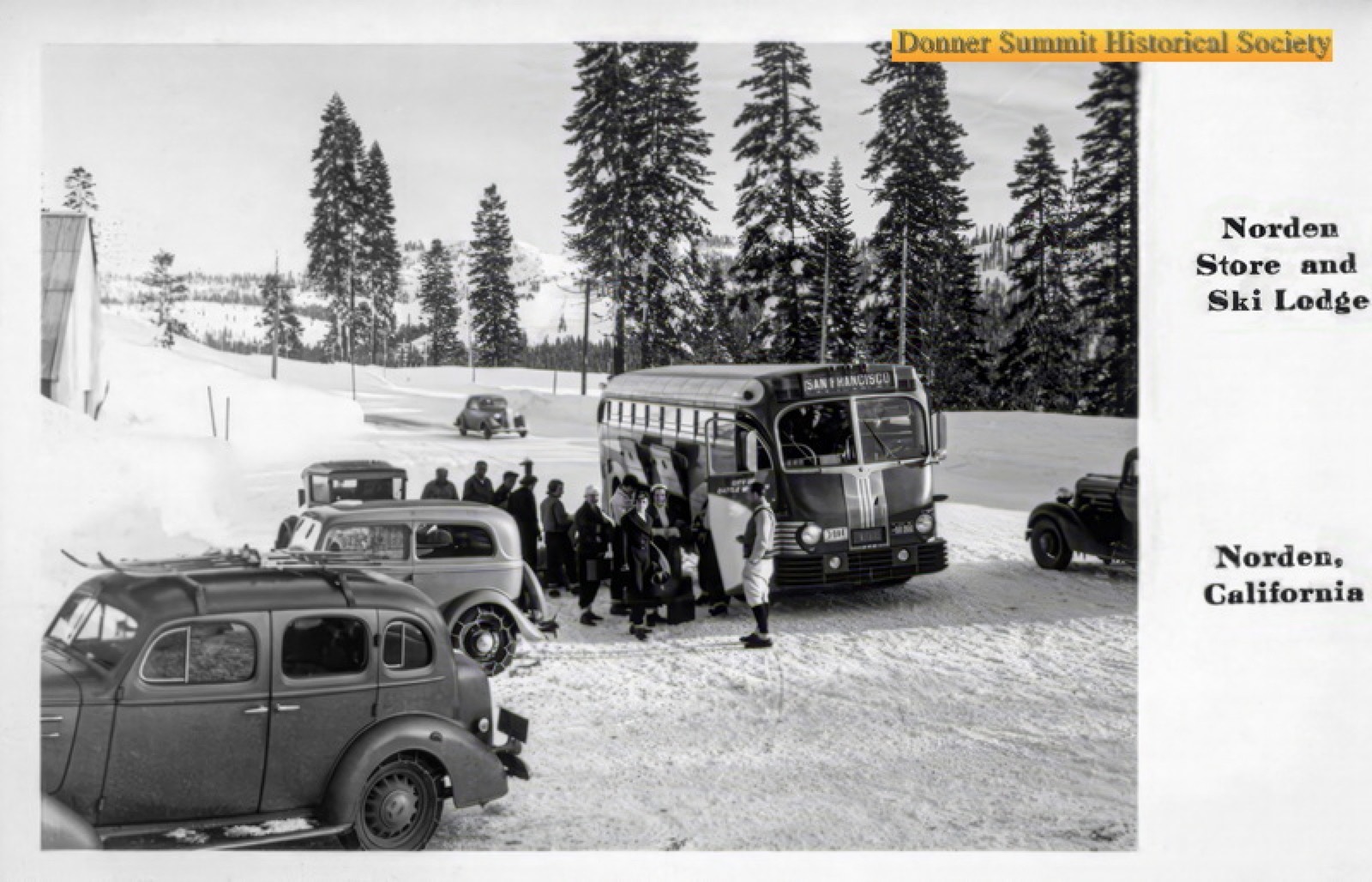
A San Francisco bus and parked cars at the Norden Store and Ski Lodge
San Francisco bus at the Norden Store and Ski Lodge.
Southern Pacific advertisement for new round-trip fares to winter sports centers including Norden and Truckee
Round-trip fares to Norden and Truckee.

Skiers on the summit

Cabins, the train step, the Auburn Ski Club, and waiting beside the track.

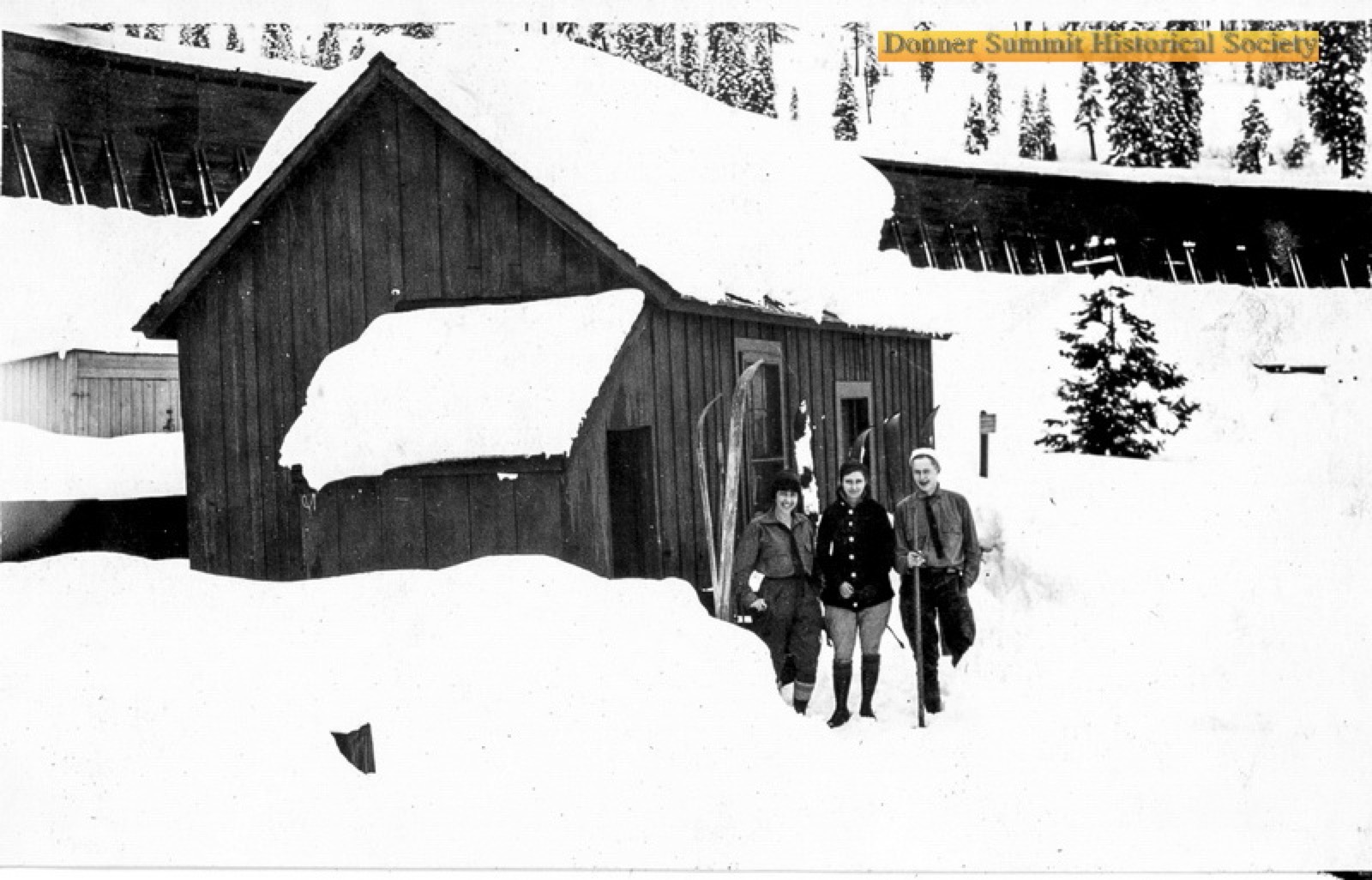
Three skiers standing beside a snow-covered wooden cabin
Skiers at a summit cabin.
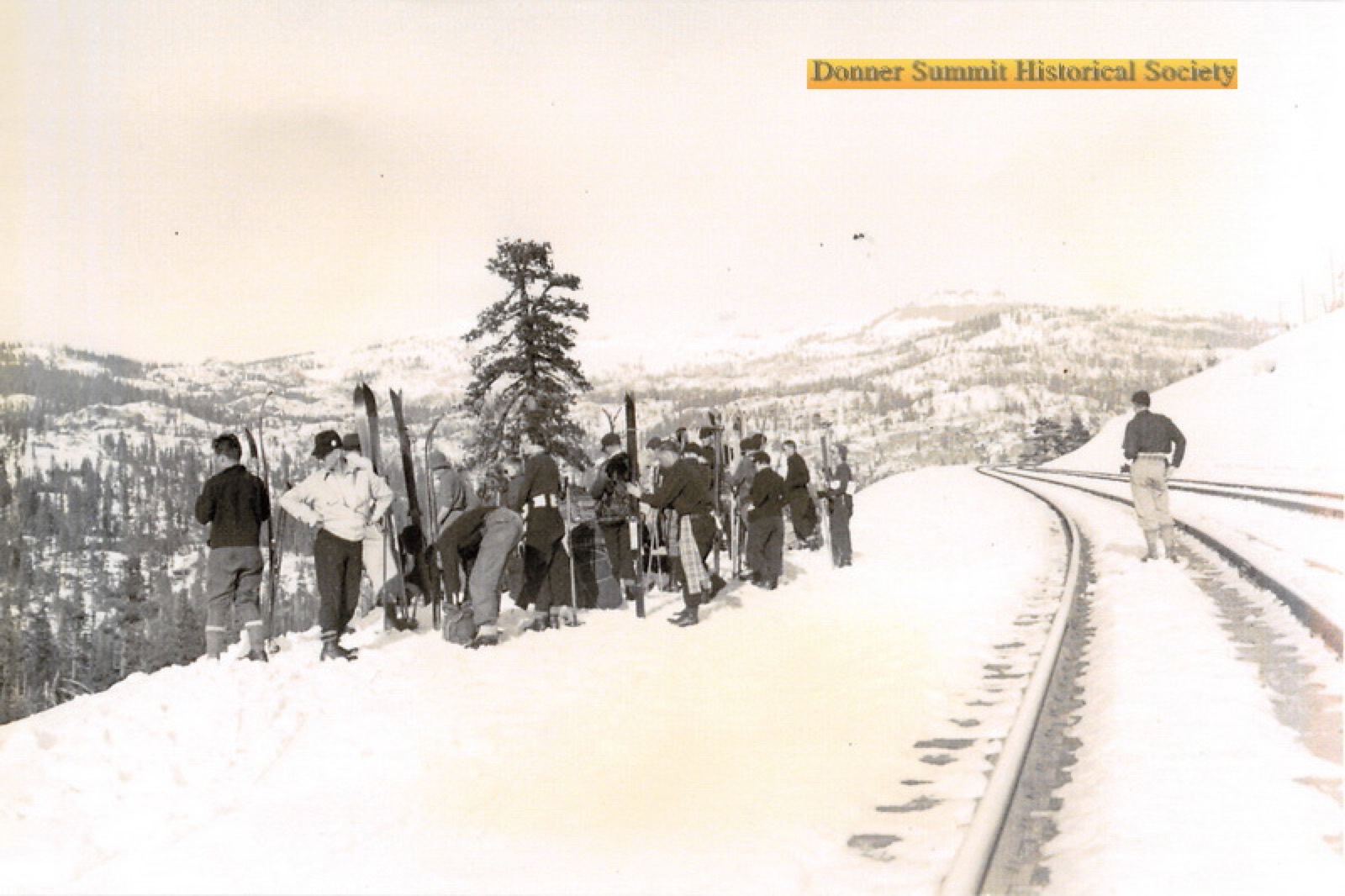
A group of skiers waiting beside the railroad track in snow
Waiting beside the track.
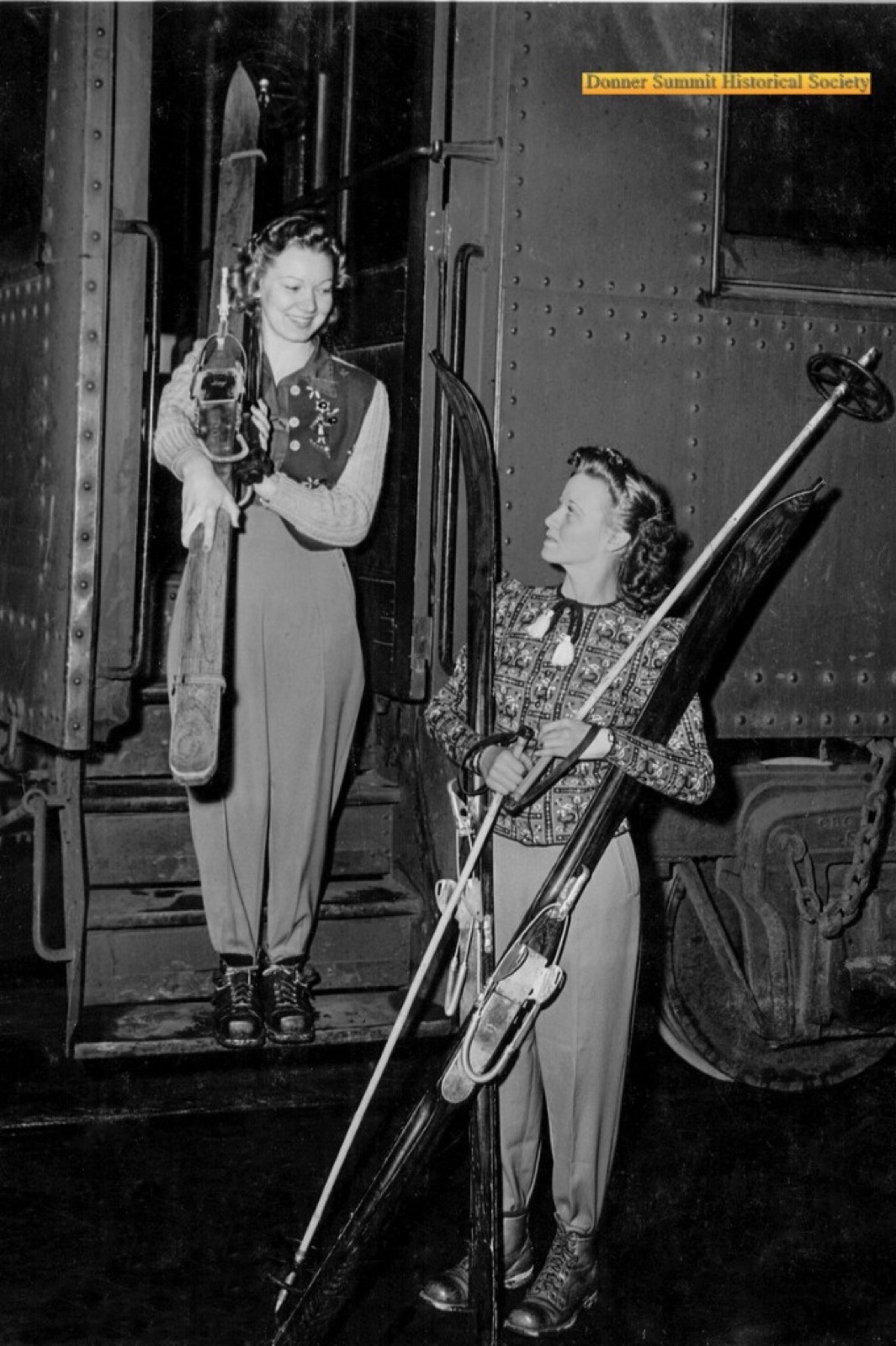
Two women with skis boarding a passenger car
Boarding with skis.
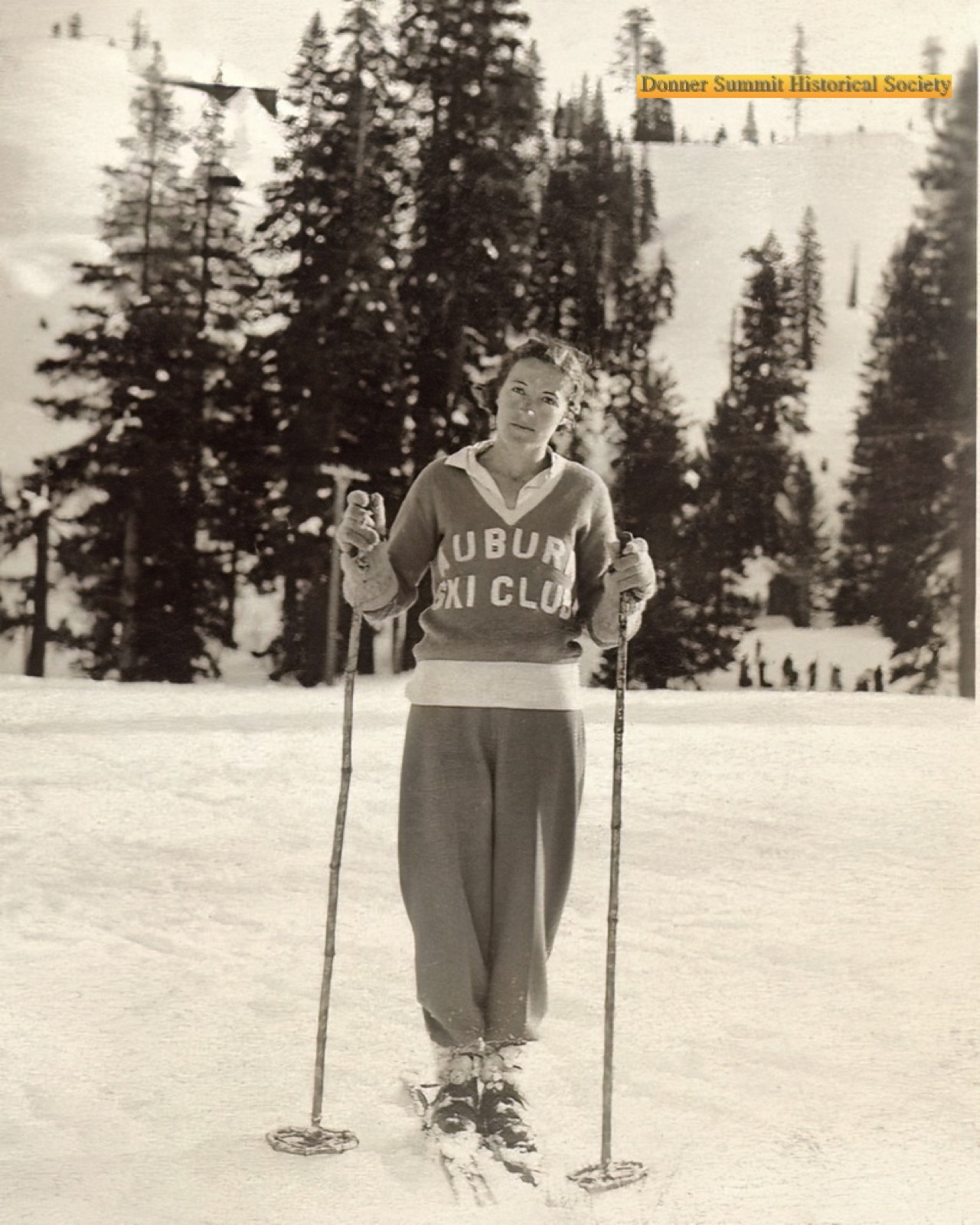
A skier in an Auburn Ski Club sweater standing on the snow
Auburn Ski Club.
Donner Summit Historical SocietyLocal archive for Norden, Sugar Bowl, the Snowball Specials, and the photographs on this page.DSHS ↗
Norden Station markerHighway 40 sign on the 1939 ski hut and overnight Snowball Express.Marker text ↗
April 2020 HeirloomDSHS newsletter with a 1940 SP ski-train brochure: times, the Ski Hut Car, and the Norden hut.PDF ↗
Sugar Bowl historyResort history, including the former ski train to Donner Summit.sugarbowl.com ↗
08 / Provenance

Sources, data and assumptions

The site is intentionally portable and works offline. External source links require internet. Timetable data are static snapshots: consult the operators for travel planning.

Union Pacific Roseville Area Employee Timetable No. 52009, pp. 24–29: track designations, curve-speed limits, operating restrictions. Not hosted here.
Capitol Corridor weekday timetableStation times on this page come from the GTFS feed, not a hosted PDF.
Capitol Corridor official GTFSUser-provided GTFS ZIP imported into the combined timetable; service calendar October 2026–January 2027.GTFS ZIP ↗ · Transitland archive ↗
Amtrak California Zephyr timetableUser-provided timetable dated November 9, 2026. Daily Emeryville–Reno station times.Official timetable ↗
Earlier concept workbookAn earlier conceptual reference only. The combined timetable now comes from GTFS.
State / regional agency plansCaltrans State Rail Plan, Capitol Corridor Vision Plan, and Placer County rail program.Caltrans ↗ · CCJPA ↗
Donner Summit Historical SocietyNorden Station marker, Heirloom newsletters, Signor book notes, and the photographs of the ski trains and snowsheds.DSHS ↗

Prepared November 9, 2026. Corrections and caveats: Historic UP track configuration is dated 2009; corridor capacity and cost figures are exploratory, not official estimates; proposed train timings are not validated with freight dispatching or station engineering; no live GTFS polling occurs inside this standalone file.